Modern military vehicle fleets are changing quickly. Platforms are becoming more digitally integrated and equipment has to remain adaptable across longer service lives. Alongside those changes, the systems used to recover and support vehicles are evolving too.
For companies working in military recovery, that means solving practical operational problems while managing challenges such as obsolescence, usability, integration and training burden. Increasingly, it also means developing equipment that can evolve alongside future vehicle programmes rather than being tied to a single platform or fixed requirement.
At EKA, several current development projects reflect that shift in thinking. From scalable peer-to-peer recovery systems to configured snatch block assemblies and modernised control interfaces, the focus is on reducing weight where possible while making recovery equipment more adaptable and easier to use in operational conditions.
Developing peer-to-peer recovery capability for LMV
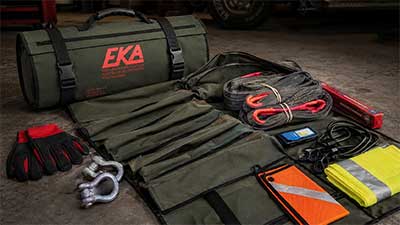 One area of current development is a scalable peer-to-peer recovery system being designed with the UK’s future light mobility vehicle (LMV) requirement in mind.
The concept centres on a heavy-duty integrated recovery package containing essential recovery and safety equipment, including strops, shackles, warning equipment and PPE. While similar systems exist in the civilian off-road market, the EKA approach has been developed specifically around military requirements and NATO STANAG 4478, which define common recovery and towing interfaces across military vehicles.
The system is intended to support level one recovery, enabling ordinary vehicle crews to recover similar vehicles safely and effectively without needing specialist recovery mechanics at the scene.
Andrew Kelly, Managing Director at EKA, said: “The emphasis has been on creating something effective and straightforward to use in operational conditions. You want equipment that reduces training burden and gives crews confidence they can use it properly when they need it.”
In practice, that can help reduce delays during routine recovery situations and limit the need to bring forward specialist recovery assets for relatively straightforward vehicle incidents.
The system has been developed around different vehicle weight envelopes and standardised mounting points aligned to STANAG 4478, creating a scalable approach that could potentially be adapted across multiple future vehicle types.
Andrew Kelly added: “A lot of the commercial systems on the market are aimed at the civilian off-road sector. What we’re developing has been designed specifically around military requirements, military standards and operational sustainability.”
The project also reflects a broader MOD focus on spiral development: improving and adapting capability incrementally over time without redesigning entire systems from scratch.
The snatch block assembly
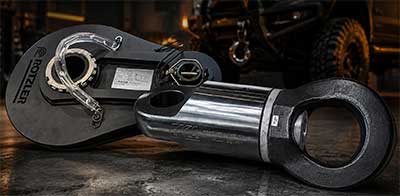 EKA has also been working on configuring a snatch block and swivel assembly intended to replace an older legacy system currently used on military recovery vehicles.
The original design dates back several decades and presents a number of practical challenges. The integrated assembly is extremely heavy, difficult to manufacture and increasingly problematic from an obsolescence and certification perspective.
The existing unit weighs more than 40 kg and requires a two-person lift during handling.
EKA’s approach separates the swivel from the snatch block itself, creating a lighter and more modular system.
The new configured assembly has been developed around a modern snatch block already compatible with current recovery vehicles including SV(R), MLRS RRV and Ajax Atlas.
Michael Keech, CEO of EKA Group Holdings, said: “A lot of capability improvement comes from understanding operational frustrations and then engineering practical ways around them. Sometimes the most valuable developments are the ones that make equipment simpler and more usable for operators.”
Reducing handling burden is particularly important in operational environments where recovery tasks may need to be completed quickly, in poor conditions or with limited personnel available.
Andrew Kelly commented: “We’re looking at how we tackle obsolescence while also making equipment easier to handle, easier to store and easier to use. That’s where a lot of practical innovation actually happens.”
Breaking the assembly into separate components allows operators to configure the system differently depending on the recovery task while also reducing stress loading during winching operations. It also gives crews greater flexibility to deploy only the equipment needed for a particular recovery scenario.
The design has been proof tested beyond the SWL of the current in-service equipment, with EKA seeing potential for future scalability and wider use across additional vehicle platforms.
Importantly, the work was not driven by a formal requirement. Instead, it emerged from EKA identifying an operational and support challenge early and developing a potential solution before the issue became critical for operators and fleet managers.
Integrating modern control architecture
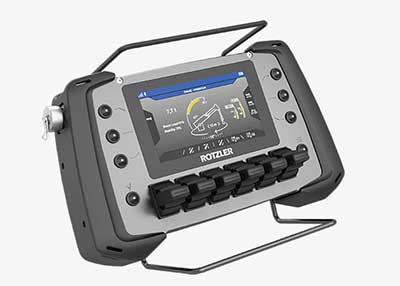 EKA is also introducing the latest APEX control system onto the new MLRS Repair and Recovery Vehicle programme, making it the first application of the system on an in-service MOD recovery vehicle in the UK.
APEX, a Rotzler system, replaces older multi-function remote control architectures that are increasingly becoming obsolete and less compatible with modern vehicle electronic systems.
While previous control units contained much of the system processing hardware internally, the newer architecture shifts more intelligence onto the vehicle itself, enabling greater flexibility and functionality through the control interface.
For operators, the benefits are less about visible technology and more about operator feedback, configurability and ease of integration.
Michael Keech said: “Recovery systems are becoming more digitally integrated alongside the vehicles themselves. The challenge is making sure recovery capability evolves with those platforms rather than falling behind them.”
The updated architecture also supports more flexible operation around the vehicle itself, helping reduce some of the compatibility and connection issues associated with older control systems.
Andrew Kelly added: “The recovery vehicle itself is becoming part of a much wider digital and electronic architecture. Integration and compatibility are becoming just as important as the physical recovery capability.”
Practical innovation driven by operational reality
Across all three projects, the common theme is not radical reinvention, but practical adaptation.
Whether reducing the weight and handling burden of recovery equipment, simplifying peer recovery for vehicle crews or integrating modern control architectures, the focus remains on solving operational problems in realistic conditions.
Michael Keech said: “A lot of the most important improvements in recovery capability are incremental. It’s about understanding operational realities, identifying future challenges early and developing solutions that remain adaptable as vehicle fleets evolve.”
As vehicle fleets continue to evolve, recovery capability will need to evolve alongside them, with systems that are not only effective today, but adaptable enough to support the next generation of military platforms in the years ahead.